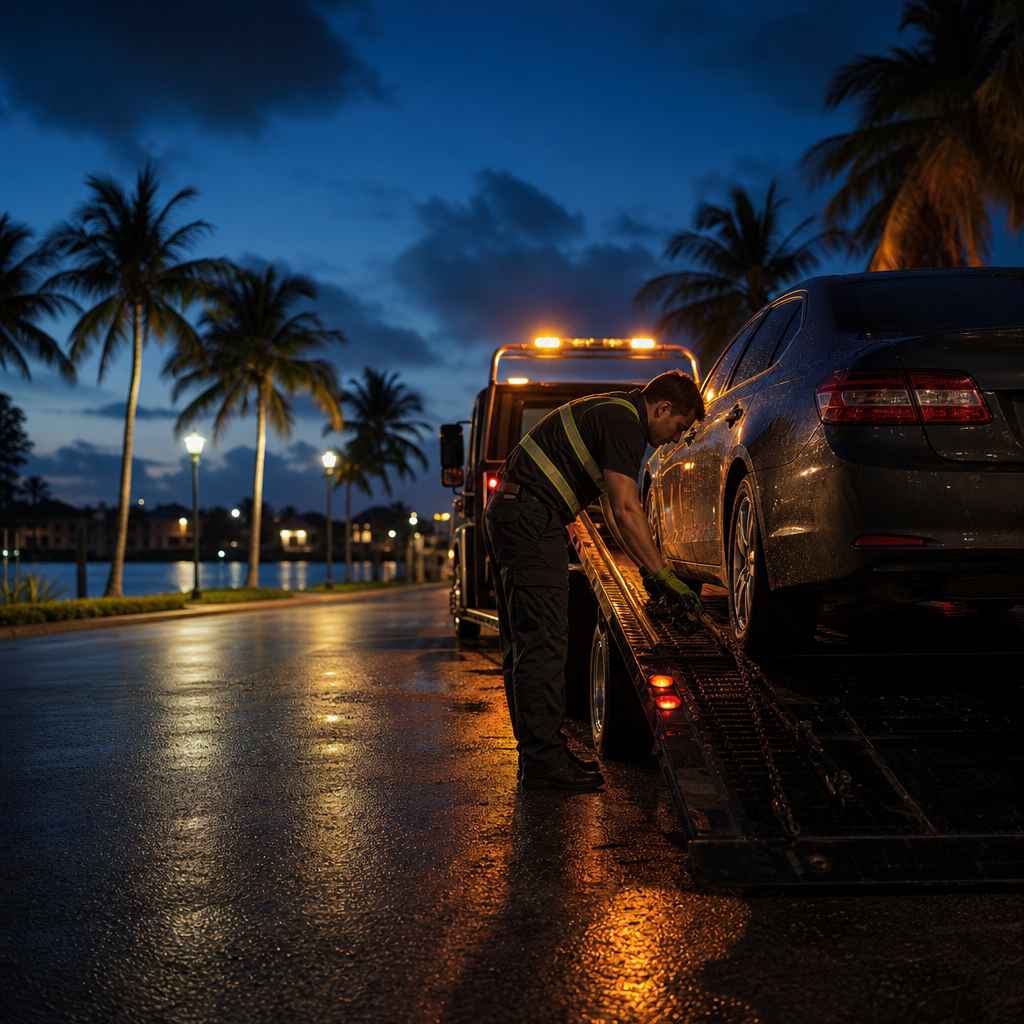
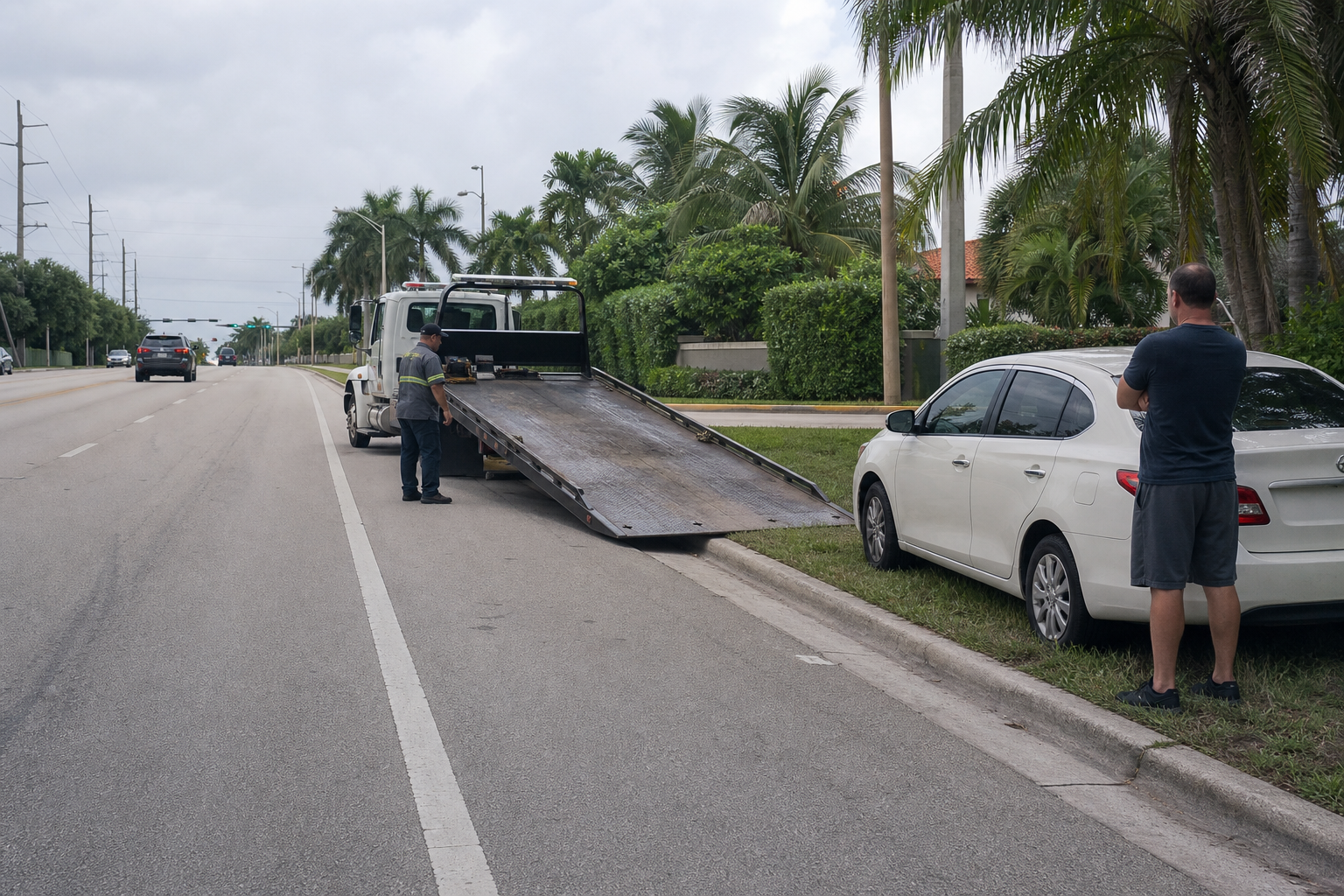
If your vehicle is slipping, will not move normally, repeatedly shifts hard, leaks fluid, enters restricted-power operation, or produces smoke or a burning odor, stop driving as soon as you can reach a safe location. Continuing through West Palm Beach can turn an uncertain drivetrain problem into a complete loss of movement. If the vehicle is disabled in an active lane, there is fire or visible smoke, or fluid is reaching hot components, move away from the vehicle if you can do so safely and contact emergency services. For other unsafe-to-drive symptoms, request 24-hour towing in West Palm Beach.
Thirty-second transmission triage
- Call emergency services first: flames, increasing smoke, strong fumes entering the cabin, fluid contacting hot parts, or a vehicle stranded where traffic creates an immediate collision risk.
- Park and arrange a tow: slipping, delayed engagement, repeated harsh shifts, loss of reverse or drive, restricted-power mode, grinding, a significant leak, or a warning accompanied by abnormal vehicle behavior.
- Do not keep testing it: repeated shifts between drive and reverse, hard acceleration, or another trip around the block can leave the vehicle unable to move at all.
A transmission warning does not identify the exact failed component. The towing decision should be based on how the vehicle behaves, what you can see or smell, and whether your stopping place protects you from traffic.
Do this—not that—while deciding on a tow
| Do | Do not |
|---|---|
| Signal early and move to the nearest safe off-lane location if the vehicle still responds normally enough to do so. | Cross multiple lanes or continue toward a preferred destination after slipping or loss of power begins. |
| Use the parking brake after stopping and keep the vehicle stationary. | Cycle repeatedly through park, reverse, neutral, and drive to see if the problem clears. |
| Report smoke, odor, leaking fluid, warning messages, and loss of movement to the dispatcher. | Describe the call only as “car trouble”; the tow operator needs the symptoms to prepare. |
| Tell dispatch if the vehicle is in a garage, gated property, narrow lot, loading area, or other access-limited location. | Assume every tow truck can reach the vehicle without clearance, gate, or turning-space information. |
| Request a transport method suitable for the vehicle and its condition. | Attempt to pull or push a drivetrain-disabled vehicle with another passenger vehicle. |
Match the symptom to the safest next move
The engine revs, but the vehicle barely accelerates
This is a common description of transmission slipping. Reduce acceleration and get out of the travel lane without asking the vehicle to cover unnecessary distance. Once parked, shut it down and request a tow. Slipping generally warrants professional assessment rather than continued travel, even if the vehicle can still creep forward.
Drive or reverse takes several seconds to engage
Delayed engagement can become no engagement. If you are already parked, leave the vehicle parked. If the delay first appears in traffic and movement is still predictable, use only the minimum movement needed to reach a safer stopping point. Do not repeatedly shift to force engagement.
The vehicle bangs, jolts, or shifts harshly more than once
One unexplained jolt deserves attention; repeated harsh shifts are a stop-driving signal. Pull over safely and arrange transport. Continuing may also make the vehicle’s speed response unpredictable around other drivers.
A transmission warning appears with restricted power
Restricted-power operation may limit speed or gear selection to protect the vehicle. It is not permission to finish the trip. Avoid merging back into traffic or attempting to drive across West Palm Beach. Park safely and arrange professional assessment by tow.
The vehicle will not move in drive, reverse, or both
Do not use high engine speed to make it move. Turn on the hazard flashers, remain belted if traffic is passing close and exiting would be more dangerous, and call for towing. Tell dispatch whether the wheels roll, the shifter moves normally, and the vehicle is blocking travel.
You see fluid, smell burning, or notice smoke
Stop and shut off the vehicle. Do not touch, taste, or crawl beneath leaking fluid, and do not open the hood if flames or heavy smoke are present. Move to a safer position away from traffic and the vehicle when possible. Fire, increasing smoke, or fluid visibly contacting hot components calls for emergency services, not only a tow request.
Step-by-step actions after you stop
- Stabilize the scene. Put the vehicle in park if possible, set the parking brake, activate hazard flashers, and assess passing traffic before opening a door. If you cannot leave an active lane, clearly tell emergency services and the towing dispatcher that the vehicle is creating a traffic hazard.
- Stop testing the transmission. Do not restart several times, rev the engine, or alternate between gears. Note what happened just before the problem: warning message, delayed shift, jolt, loss of acceleration, odor, smoke, or fluid.
- Confirm your location precisely. Tell dispatch “West Palm Beach, Palm Beach County,” rather than using “Palm Beach” alone. Provide the street address or nearest cross street shown on your map, your direction of travel, and which side of the property or roadway you occupy.
- Describe access before a truck is assigned. Mention a garage level and posted clearance, gate code, staffed entrance, narrow driveway, loading zone, soft ground, tight corner, or property rule affecting entry. If the vehicle is inside a structure, say whether it can roll and whether there is room in front of it.
- Identify the vehicle completely. Give the year, make, model, approximate size, drivetrain if known, and whether it is electric, hybrid, all-wheel drive, or four-wheel drive. Report collision damage or wheels that appear locked or out of position.
- Ask for the appropriate tow setup. A flatbed tow is often suitable when drivetrain condition is uncertain or driven wheels should remain off the road. The towing provider should choose equipment using the vehicle specifications, access constraints, and wheel condition—not the warning light alone.
- Choose a safe waiting position. Follow dispatcher or emergency-service instructions. Do not stand between the disabled vehicle and approaching traffic, beside the loading path, or behind the tow truck during positioning.
Dispatcher-ready checklist for West Palm Beach
- Exact West Palm Beach location and confirmation that it is in Palm Beach County
- Street address, nearest cross street, travel direction, and side of the roadway or property
- Active lane, shoulder, parking lot, driveway, gated property, or garage location
- Garage clearance, level, entrance instructions, gate code, and available turning room
- Vehicle year, make, model, size, drivetrain, and power type
- Whether drive or reverse engages and whether the vehicle rolls in neutral
- Dashboard warning wording or symbol color
- Slipping, harsh shifting, grinding, leak, burning odor, smoke, or restricted power
- Number and position of passengers, especially if anyone cannot reach a safe waiting place
- Requested destination or confirmation that you need time to choose one
This information helps a 24-hour towing dispatcher evaluate urgency, access, and equipment without asking you to perform unsafe roadside tests.
Questions drivers ask before the truck arrives
Can roadside assistance repair a transmission at the vehicle?
Transmission warnings usually require diagnosis in a controlled service setting. Roadside help may address safe positioning or transport, but it should not be expected to confirm an internal transmission failure beside traffic. If normal movement is uncertain, towing is the practical next step.
Why does the dispatcher ask whether the vehicle rolls?
A vehicle that cannot roll may need different loading preparation than one that can be shifted into neutral. The answer also helps the operator plan for a garage, tight lot, incline, or position where direct truck alignment is limited. Say “unknown” rather than testing in an unsafe place.
Should I pour in transmission fluid before calling?
Do not add fluid roadside unless the vehicle manufacturer’s instructions clearly support it and you can work in a genuinely safe location. Different vehicles have different fluid specifications and checking procedures, and some do not provide a simple driver-accessible fill point. A visible leak or uncertain fluid level supports towing rather than guesswork.
Does a disappeared warning mean the vehicle is safe to drive?
No. A warning that clears after shutdown does not erase slipping, delayed engagement, restricted power, harsh shifts, odor, or leakage. Record the message if you can do so without delaying your move to safety, then base the tow decision on the symptoms that occurred.
Make the safety call, not the distance call
A short remaining trip is not a useful reason to continue with slipping, repeated harsh shifts, restricted power, loss of gear engagement, smoke, or leaking fluid. Park where you are protected from traffic and request towing. If there is fire, increasing smoke, hazardous fluid near hot components, or immediate danger from an active-lane breakdown, contact emergency services first; otherwise, call for safe vehicle transport in West Palm Beach and provide the location and access checklist above.