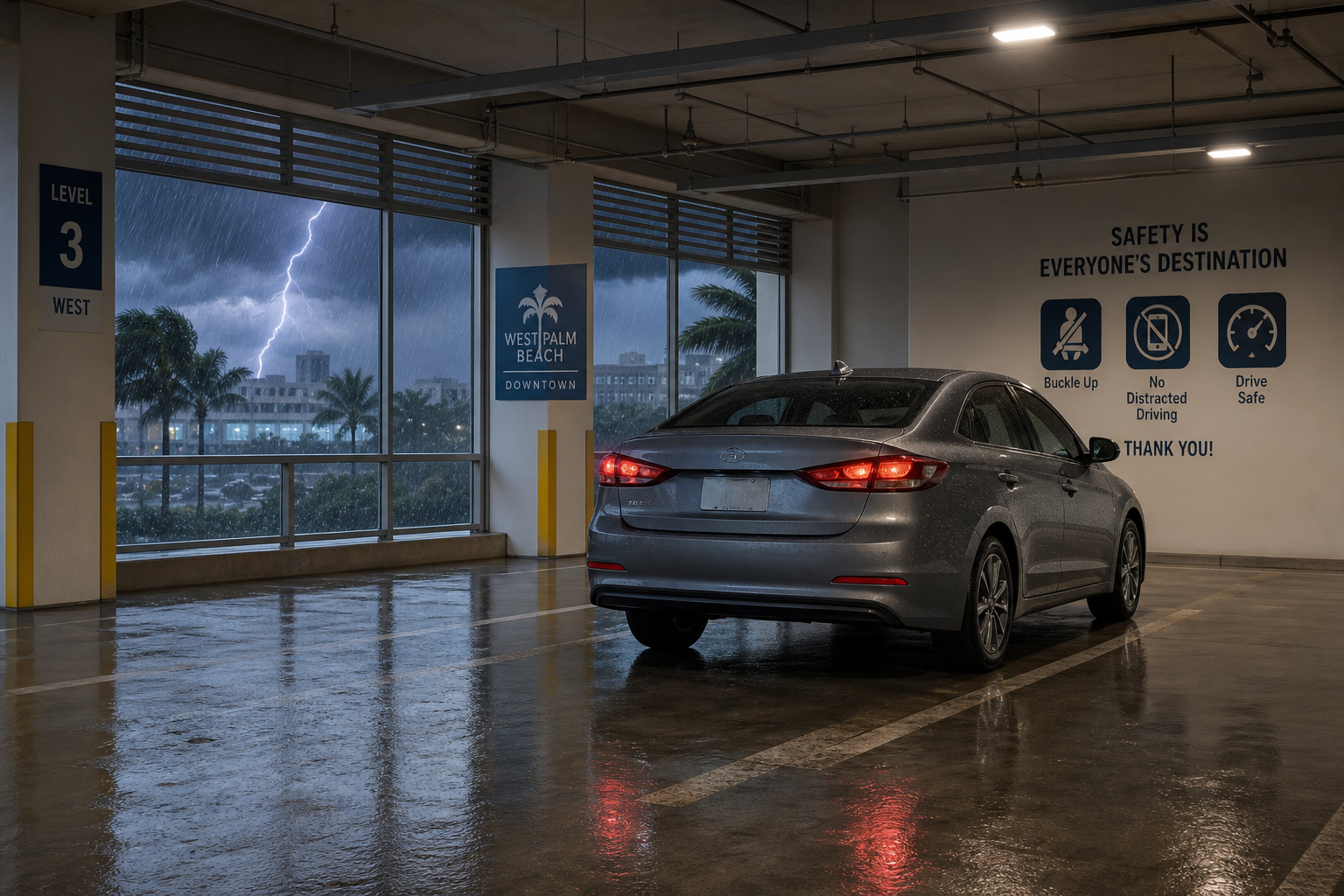
- Stay inside a fully enclosed, hard-topped vehicle with the windows closed.
- Do not stand outside beside the vehicle, under a tree, under an overpass, or in an open-sided parking garage.
- Move only if remaining in place creates a greater danger, such as rising water, a fire, traffic exposure, or a downed power line.
- If you need towing, share your precise safe location, direction of travel, nearby exit or cross street, and any hazards with the dispatcher.
A sudden South Florida thunderstorm can turn a straightforward breakdown into a difficult decision: stay with the vehicle, move to shelter, call for a tow, or contact emergency services. For a driver in West Palm Beach, the safest answer depends on the immediate hazard—not simply whether the car is disabled.
Lightning, flooded pavement, fast-moving traffic, and damaged utility equipment require different responses. The goal is to get yourself into a safer location first, then make the vehicle-recovery plan. A tow can be arranged after you are out of immediate danger.
The safest places to wait during nearby lightning
The National Weather Service advises people to seek a substantial enclosed building or a fully enclosed, metal-topped vehicle when thunder is heard. For a driver who is stranded but not in another immediate hazard, the vehicle is usually the practical shelter.
Use your enclosed vehicle as shelter when it is safely positioned
If your car is off the travel lane, not taking on water, not near a downed line, and not at risk of being struck, remain inside. Keep the doors closed and windows up. Avoid leaning against metal door frames or touching unnecessary metal components. Do not exit simply to inspect a tire, look under the hood, direct traffic, or wait for a tow driver in the rain.
A vehicle does not need to be running to provide lightning shelter. What matters is that it is fully enclosed and safely located. Convertibles with soft tops, open utility vehicles, golf carts, and open-sided structures are not comparable shelters.
Choose a fully enclosed building if you can reach one without added risk
A fully enclosed building is a good option only when it can be reached safely before conditions worsen. Examples may include an open business, a staffed public building, or another substantial enclosed structure. Do not run across active lanes, cross flooded pavement, or leave a reasonably safe vehicle on a high-speed roadway just to reach a building.
Do not treat a typical parking garage as lightning shelter. Many garages are open-sided, which leaves occupants exposed to wind-driven rain and lightning risk. Avoid bus shelters, covered walkways, pavilions, porches, dugouts, trees, and highway overpasses.
On I-95, the Turnpike, or another high-speed route: prioritize traffic safety
Being stopped on a limited-access highway can be more dangerous than the storm itself. If your vehicle is still controllable, use hazard lights and move as far from active lanes as practical. Aim for an exit, service plaza, designated safe area, or other location away from fast traffic rather than stopping on a narrow shoulder.
On routes such as I-95, Florida's Turnpike, or busy West Palm Beach corridors including Okeechobee Boulevard, Southern Boulevard, and US-1, do not stand outside the vehicle to wave for help. Stay belted inside if traffic is close and exiting would put you in the path of vehicles.
Once safely stopped, check Florida 511 for traffic incidents, closures, and roadway conditions when it is safe to use your phone. Follow instructions from FDOT personnel, law enforcement, fire-rescue crews, or other roadway responders. If a crash, blocked lane, disabled vehicle location, or dangerous weather creates an immediate threat, call 911 rather than trying to manage the situation yourself.
When rain becomes a flood emergency
Heavy rain can conceal deep water, washouts, debris, and stalled vehicles. The correct action changes depending on whether your vehicle is still operating.
If the vehicle is still running
Do not drive into water covering the road. Turn around and use another route. Even shallow-looking water may hide a damaged surface or become deeper quickly. If water begins rising around the vehicle while it is still operating, leave the flooded area only if there is a clearly visible, safe route to higher ground. Do not attempt to push through moving water.
If the vehicle has stalled in rising water
A stalled vehicle should not be treated as a routine towing wait. Call 911 if water is rising, entering the cabin, or moving the vehicle. Unbuckle seat belts, unlock doors, and prepare to leave the vehicle if you can reach higher ground without entering moving water or crossing a dangerous traffic area. Do not wait for a tow truck inside a vehicle that is filling with water.
If escape is not safely possible, call 911, tell the dispatcher that the vehicle is stalled in rising water, and give your location as precisely as possible. Palm Beach County emergency resources and local responder updates may also provide storm-related road information, but emergency instructions take priority.
Downed power lines: do not turn this into a towing call first
If a wire is on, touching, or close to your vehicle, assume it is energized. Stay inside unless there is an immediate life-threatening reason to leave, such as a vehicle fire. Do not touch the vehicle and the ground at the same time, do not touch puddles near the line, and do not let other people approach.
Call 911 and report the location, then notify the local electric utility if directed. A towing company should not be expected to approach a vehicle until the electrical hazard has been made safe.
If fire or another immediate threat forces you out, Florida Power & Light's public power-line safety guidance advises jumping clear without touching the vehicle and ground at the same time. Land with both feet together, then shuffle away with small steps while keeping your feet close together. Once clear, stay at least 35 feet away from the vehicle, wire, and anything the line may be touching—or farther away if responders direct it. Keep others back as well.
What to tell a towing dispatcher during a storm
Clear information helps a towing provider plan a safer pickup and determine whether standard towing or a flatbed is appropriate. Before calling, gather details from inside your vehicle if possible:
- Your exact location: street, direction of travel, nearby intersection, mile marker, exit number, business, or landmark.
- Whether you are on a shoulder, in a parking lot, at a residence, or blocked in a lane.
- The vehicle's condition: disabled, flat tire, no-start, collision damage, or unable to move safely.
- Any hazards: lightning nearby, standing water, traffic exposure, downed lines, debris, or smoke.
- Whether passengers are safe and whether you have already contacted emergency services.
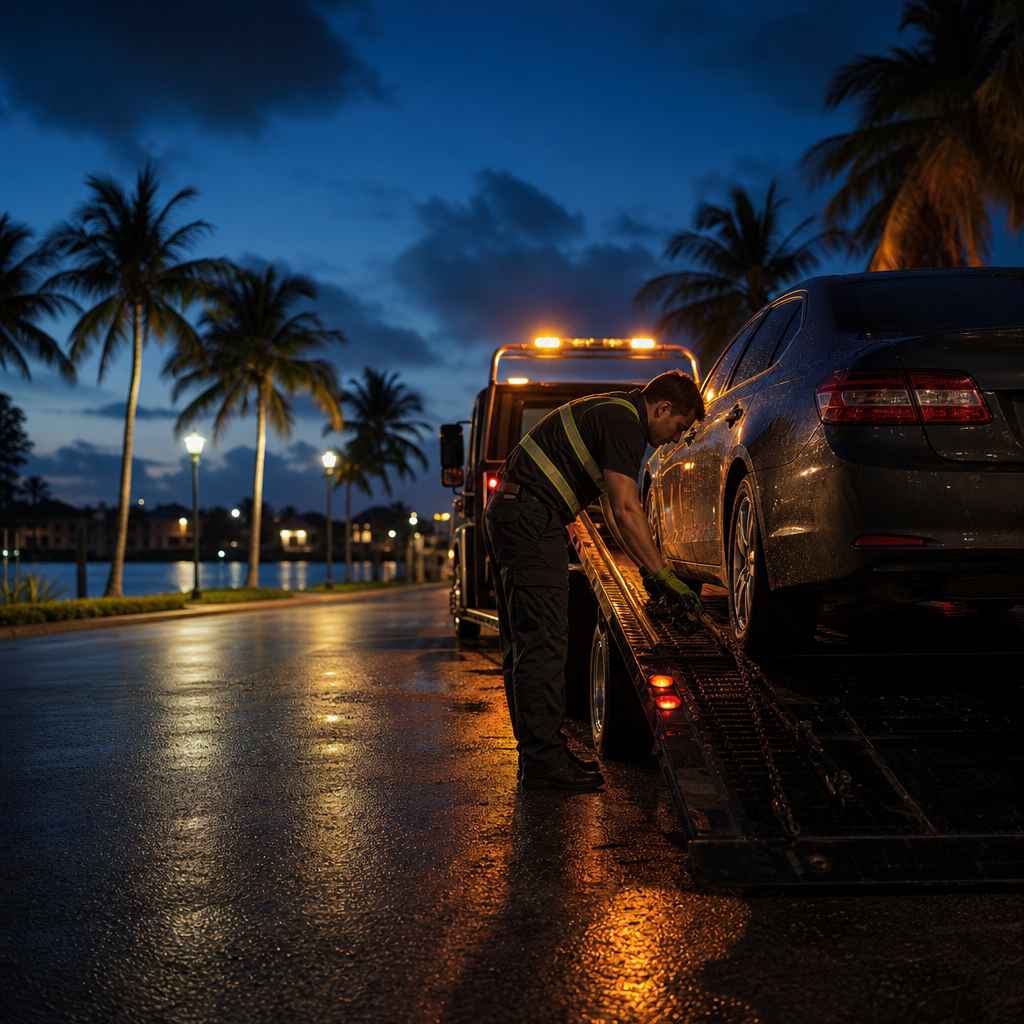
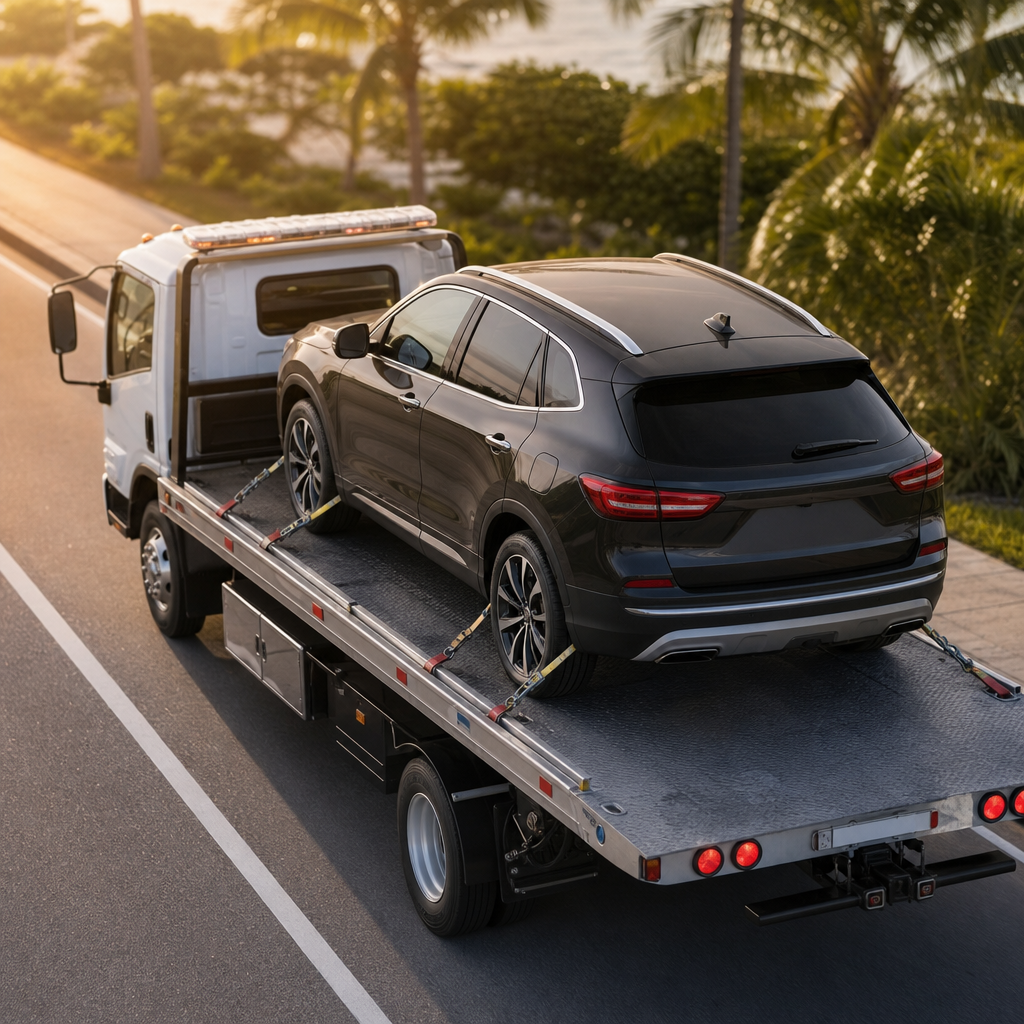
If your vehicle cannot be driven without risking further damage, request help rather than repeatedly trying to restart or move it. A 24-hour towing service can be the right next step after the scene is safe. For a vehicle that should be carried rather than rolled, ask about flatbed towing.
A short waiting checklist for stranded drivers
- Keep seat belts on when stopped near fast traffic.
- Use hazard lights when they are functioning and appropriate for visibility.
- Keep your phone charged if possible, but avoid handling electronics while outside during lightning.
- Share your location with a trusted contact if you are waiting for assistance.
- Do not accept help that requires you to stand in a travel lane, enter floodwater, or approach electrical equipment.
- Wait at least 30 minutes after the last sound of thunder before returning to outdoor tasks, consistent with National Weather Service lightning guidance.
When to call for help immediately
Call 911 first when there is a crash with injuries, a vehicle blocking an active lane, a fire, rising floodwater, a downed power line, smoke, or an unsafe traffic situation. For a non-emergency breakdown in a safe location, request towing assistance in West Palm Beach and remain in your enclosed vehicle until help arrives.
Do not assume a tow provider can safely reach a vehicle in floodwater or near damaged electrical equipment. Those conditions may require emergency responders or utility crews to secure the scene before recovery can begin.
Frequently asked questions
Is my car safe during lightning if it will not start?
Usually, a fully enclosed hard-topped vehicle is safer than being outside during lightning, even if the engine will not start. Stay inside only if the vehicle is not in floodwater, near a power line, on fire, or exposed to immediate traffic danger.
Should I wait under an overpass during a thunderstorm?
No. Overpasses can create traffic hazards and do not provide appropriate lightning shelter. Remain in an enclosed vehicle if it is safely positioned, or seek a fully enclosed building when safely accessible.
Can a tow truck pick up my vehicle during lightning?
Weather may affect when and how a towing provider can safely work. Give the dispatcher accurate hazard information. If lightning, flooding, traffic, or electrical damage makes the scene unsafe, recovery may need to wait until conditions allow.
What should I do if a power line falls on my car?
Stay inside, call 911, and keep everyone away from the vehicle. Do not exit unless fire or another immediate threat requires it. If emergency exit is necessary, jump clear and shuffle away, then remain at least 35 feet away unless responders give different instructions.