
West Palm Beach
24-Hour Towing in West Palm Beach
Compare flatbed and wheel-lift towing risks, access needs, and vehicle-handling factors before requesting a tow in West Palm Beach, Florida.
Availability and pricing are confirmed on the call.
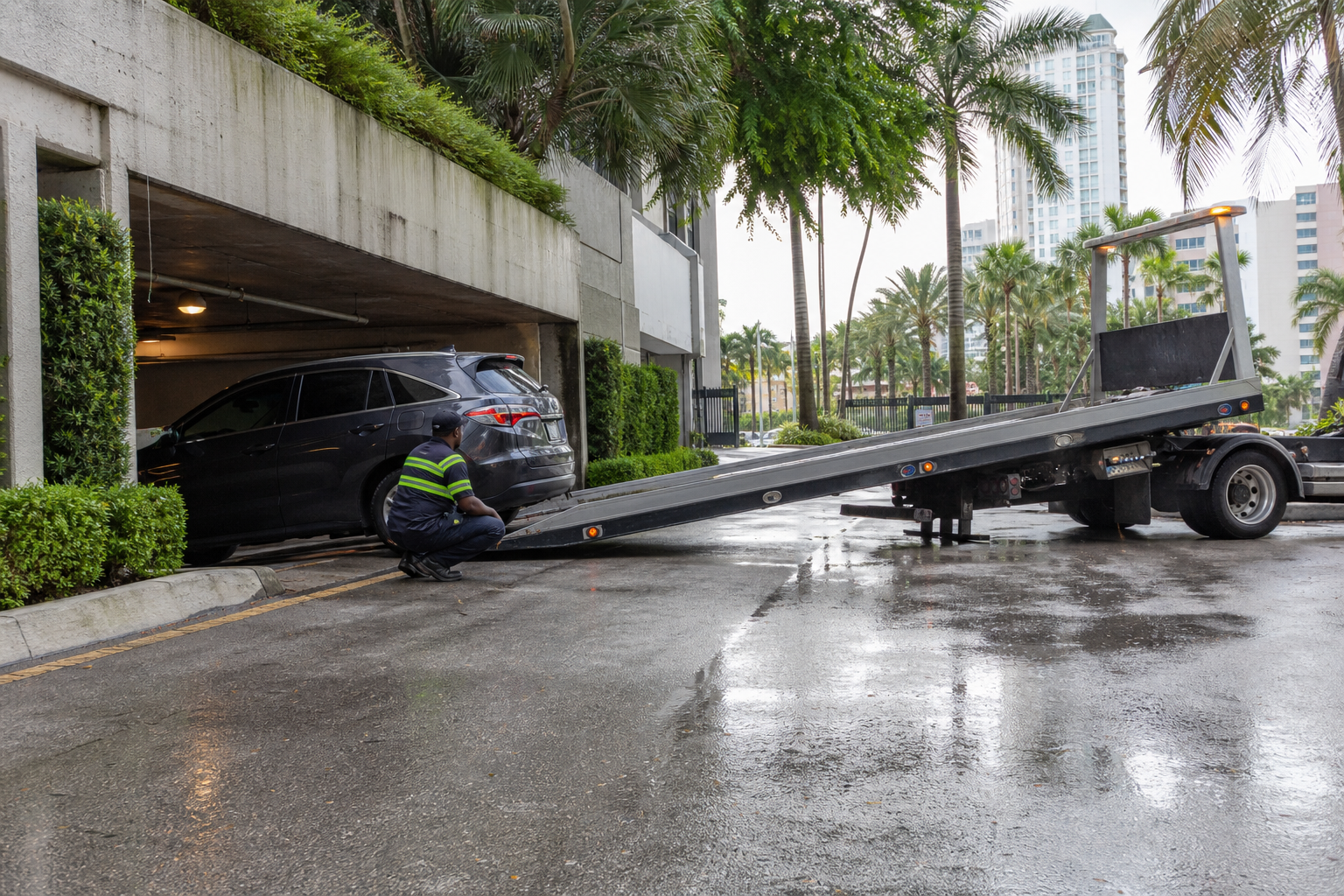
Use this rule first: request a flatbed when the vehicle should not roll on any wheel; consider a wheel-lift when the correct axle can be raised and the remaining wheels can roll safely. If clearance prevents either truck from reaching the vehicle, ask for an extraction plan rather than guessing at the tow method.
A realistic choice: the disabled vehicle inside a covered garage
Picture a crossover that will not move from a parking space in West Palm Beach. One wheel appears out of line, the transmission will not shift normally, and the exit has limited overhead clearance. The driver may assume that asking for a flatbed solves every problem.
A flatbed may be the right transport method, but it cannot help if the truck cannot enter the structure. The vehicle might first need to be moved to an accessible loading area with a wheel-lift, dollies, skates, or other handling equipment. The safest answer can therefore involve two stages: controlled extraction followed by flatbed transport.
The useful question is not simply, “Which truck is better?” It is, “Which wheels can roll, what can reach the vehicle, and how should it be moved from its current position?”
Immediate response: protect people before protecting the vehicle
Do this now:
- Assess your exposure. If the vehicle is in an active lane, on a garage ramp, near a blind corner, or anywhere approaching drivers may not see it, prioritize getting yourself and passengers to a safer position. Do not remain beside the vehicle to inspect damage.
- Warn others if you can do so safely. Activate hazard lights. Use a warning device only when placing it will not expose you to moving traffic.
- Stop attempting to drive if a wheel is bent, locked, detached, or rubbing. Further movement can worsen suspension, tire, body, or driveline damage.
- Do not crawl under the vehicle. A damaged or unevenly positioned vehicle can shift without warning.
- Call for towing help when safe movement is uncertain. Describe what happened and what the vehicle is doing instead of diagnosing the failure yourself.
South Florida rain can hide pavement edges, debris, and standing-water depth. If water is rising or traffic visibility is poor, move to personal safety and tell the towing dispatcher about those conditions. In high heat, wait in a safe sheltered or air-conditioned location when available; do not remain in an exposed traffic area merely to watch for the truck.
Location and access can decide the method
West Palm Beach pickups can involve open lots, covered parking, narrow service areas, residential entrances, or vehicles positioned close to walls and columns. A flatbed requires more than enough space for the truck itself: the operator also needs room to lower and extend the deck, align the vehicle, load it, and secure it.
Before requesting equipment, check these factors from a safe position:
- Overhead clearance: report the posted clearance and any lower pipes, signs, gates, or ceiling sections along the route.
- Approach space: mention tight turns, columns, parked vehicles, steep transitions, gates, or dead-end aisles.
- Wheel condition: identify any wheel that is locked, missing, folded inward, or pressed against the body.
- Vehicle position: say whether it faces into a space, sits against a wall, blocks a ramp, or cannot be approached from the front or rear.
- Surface condition: report flooding, soft ground, oil, loose material, or a sharply sloped loading area.
Do not move another vehicle, enter standing water, or attempt to guide a tow truck through a hazardous area. Access details let the towing service plan before arrival.
Service handoff: compare the handling risks
| Condition | Flatbed considerations | Wheel-lift considerations |
|---|---|---|
| Vehicle can roll and steer normally | Provides transport with the vehicle secured on the deck, assuming there is adequate loading space. | May be suitable when the correct axle is lifted and the wheels left on the road can rotate safely. |
| Locked, damaged, or misaligned wheel | Often preferred for transport, but the vehicle still needs careful loading. Skates, dollies, a winch, or other aids may be needed before it reaches the deck. | The damaged end may be lifted. Dollies may be required if the other wheels must not roll. |
| All-wheel-drive or uncertain drivetrain | Commonly selected to avoid rolling a connected axle during transport, subject to the vehicle maker’s towing instructions. | Should not be assumed suitable without the correct configuration and equipment. |
| Low-clearance or confined pickup | May be unable to reach or load at the vehicle’s current position. | Can sometimes assist with extraction where a flatbed cannot operate, followed by a transfer outside. |
| Very low bodywork | Deck angle and vehicle clearance must be evaluated to avoid contact during loading. | Lift-point access and body clearance must be evaluated before raising the vehicle. |
Flatbed transport reduces rolling contact with the road after loading, but it does not make loading risk-free. A vehicle with seized wheels, collapsed suspension, or low bodywork needs appropriate aids, alignment, and securement. A wheel-lift is not automatically a lesser service; it can be the practical tool for a movable vehicle or a constrained extraction when configured correctly.
If the vehicle clearly requires deck transport, review flatbed towing service information. If the situation occurs after normal business hours or the vehicle is creating an unsafe obstruction, use 24-hour towing assistance.
Information to give the towing dispatcher
A clear handoff reduces the chance of sending equipment that cannot reach or safely handle the vehicle. Have this checklist ready:
- Exact pickup location, including garage level, space, gate, or entrance instructions
- Vehicle year, make, model, and approximate size
- Drive type if known; say “unknown” rather than guessing
- Whether the vehicle starts, shifts into neutral, steers, and releases the parking brake
- Which wheels roll and any visible tire, wheel, suspension, or body damage
- Posted overhead clearance and restricted approach areas
- Destination name and confirmation that the destination can receive the vehicle
- Any rain, standing water, traffic exposure, or other condition affecting access
Call for professional help now if the vehicle cannot roll normally, steering is compromised, fluid is leaking, a wheel is visibly displaced, the vehicle is exposed to traffic, or you cannot determine how to move it without causing more damage.
Questions drivers ask before choosing a tow method
Can roadside assistance solve the problem without towing?
Possibly, if the symptom is caused by a serviceable issue such as a depleted battery. Describe the symptoms when calling. If there is wheel, suspension, collision, steering, or fluid-leak damage, avoid attempts to make the vehicle drivable at the pickup point.
What photos are useful to the towing service?
From a safe location, photograph the vehicle’s overall position, visible wheel damage, posted garage clearance, and the approach area. Do not step into traffic, stand on a ramp, or enter water to obtain a better angle.
Should loose items be removed before the tow?
Take essential belongings and secure loose items that could shift. Do not climb into an unstable vehicle or delay removal from a hazardous location to organize property.
What if the destination is closed?
Confirm where the vehicle may be left, who can accept it, and how access will work. Do not assume an unattended delivery is permitted. If acceptance is uncertain, discuss destination options before the vehicle is loaded.
Request the right equipment with the first call
For towing in West Palm Beach, be ready with the vehicle type, wheel condition, drivetrain if known, pickup access, overhead clearance, and destination. Ask the dispatcher to determine whether the job requires flatbed transport, wheel-lift handling, dollies, or a staged extraction.
Let’s talk through it
Where do you
need to go?
Call with your location and vehicle details.