
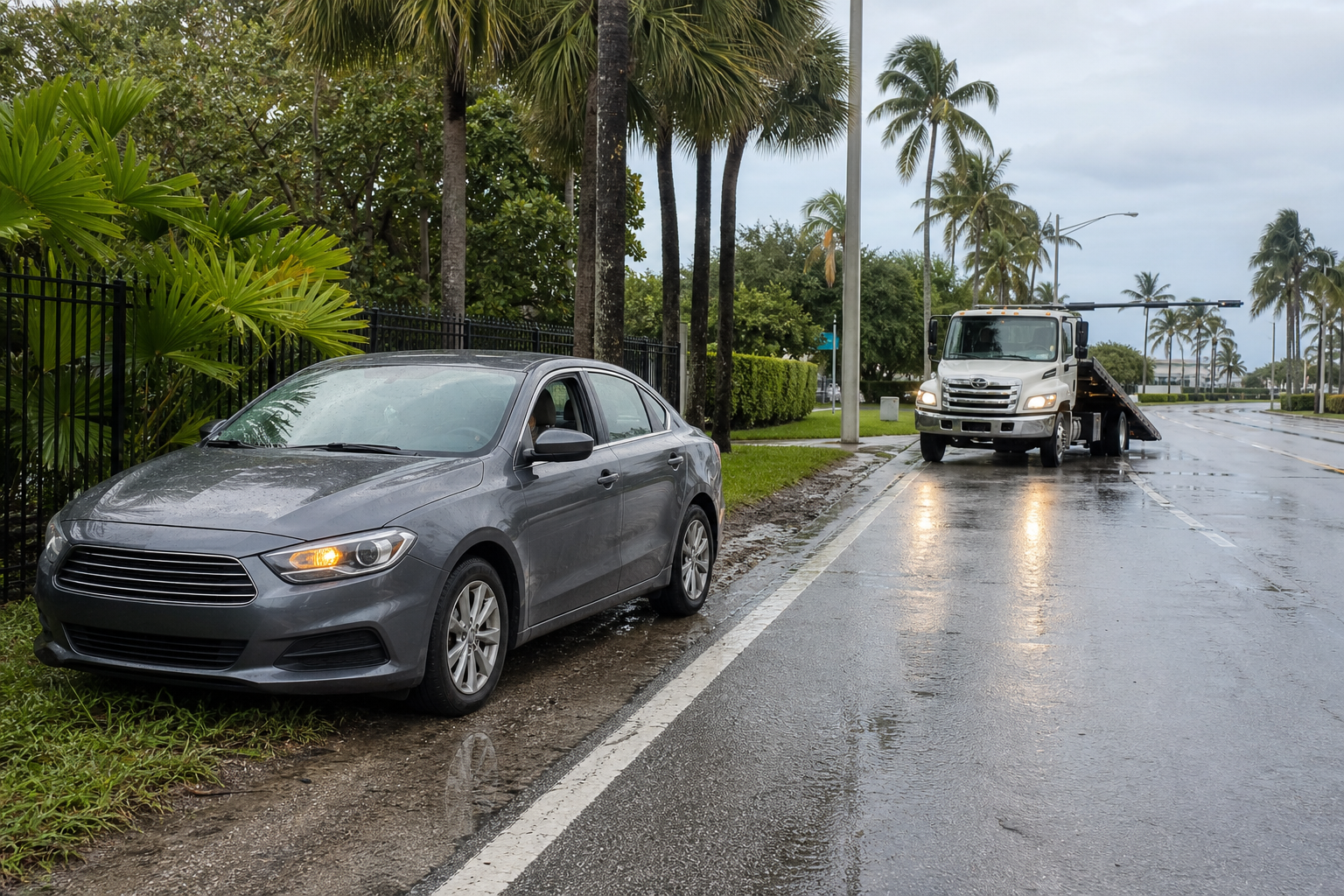
A sudden West Palm Beach downpour changes how you should handle an engine that will not start. Wet pavement, reduced visibility, and standing water can make roadside troubleshooting more dangerous than the vehicle problem itself. If the engine stopped after entering water, do not keep trying the ignition. Move directly to the safety and towing decision below.
The first 10 minutes: observe before trying again
Minutes 0–2: make the location safer
Do not begin under-hood checks while part of the vehicle is exposed to traffic. If the car has enough momentum or electrical power to move completely off the traveled area, do so only when the path is clear. Otherwise, use the hazard lights and request assistance. If smoke, fire, or a strong fuel smell is present, leave the immediate area when there is a safe route away from traffic.
Minutes 2–5: identify what “will not start” means
With the transmission in Park and your foot on the brake, make one brief start attempt. Listen and watch the dashboard:
- No sound and no dashboard lights: the vehicle may have lost electrical power.
- Rapid clicking: low battery power or an electrical connection problem is possible.
- One solid click: the battery, starter, or another starting-system component may be involved.
- The engine turns over but never starts: this is a crank-no-start condition. Repeated attempts are unlikely to make the roadside situation safer.
- The engine starts and immediately stalls: do not assume the vehicle can complete the trip.
These clues help dispatch choose between a possible roadside attempt and towing; they are not a final diagnosis.
Minutes 5–10: stop repeated attempts
After one or two brief attempts, pause. Continued cranking can drain the remaining battery power and make the symptoms harder to assess. Do not crawl beneath the vehicle, touch hot components, disconnect cables, or open a pressurized cooling system.
Check only what can be observed safely from the driver’s seat: fuel gauge, warning lights, gear position, and whether exterior lights remain bright. Note what happened immediately before the failure, including loss of power, unusual noise, overheating indication, heavy rain, or contact with standing water.
Decision points: roadside attempt, tow, or cautious drive?
Request roadside assistance when the setting is safe and the symptoms are limited
A roadside attempt may be reasonable when the vehicle is fully out of traffic, there is no smoke or leaking fluid, the engine did not stall in water, and the main symptom is weak electrical power or clicking. A provider can assess whether a jump-start attempt is appropriate. If the vehicle cannot be reached safely or a jump does not restore dependable operation, towing becomes the safer next step.
Request a tow without another start attempt when:
- The engine stopped during or after contact with standing water.
- There is smoke, a burning odor, a strong fuel smell, or visible fluid loss.
- The vehicle overheated or displayed a critical warning before shutting down.
- The engine cranks normally but will not start.
- The vehicle starts and repeatedly stalls.
- Steering, braking, lighting, or other essential controls do not operate normally.
- The car is in an exposed position where roadside work would be unsafe.
- There is visible damage or unusually low ground clearance that affects loading.
For around-the-clock help, use 24-hour towing in West Palm Beach. Tell dispatch if the vehicle may need flatbed towing because of damage, low clearance, an all-wheel-drive configuration, or manufacturer transport instructions.
If a jump-start works, should you drive?
A successful jump does not confirm that the problem is solved. Before moving, let the vehicle run while you check for warning lights, rough operation, smoke, unusual odors, dimming lights, or another stall. If any appear, switch off in a safe location and request a tow.
A direct drive for inspection may be reasonable only when the engine continues running normally, essential controls work, there are no critical warnings, visibility is adequate, and the route does not require taking a vehicle you distrust back into hazardous conditions. Avoid unnecessary stops because the engine may not restart. If you are uncertain about its condition, towing avoids turning a stationary no-start into a moving breakdown.
What to report when you call
A precise report helps the provider plan access, equipment, and the safest next action. Have this checklist ready:
- Your location in West Palm Beach, Palm Beach County, plus a clear description of where the vehicle is positioned.
- Vehicle year, make, model, color, and approximate size.
- Whether the vehicle is in Park, whether the steering unlocks, and whether it can roll.
- Whether you hear silence, rapid clicks, one click, normal cranking, or a brief start followed by stalling.
- Which dashboard lights appear and whether the exterior lights are strong or dim.
- Any smoke, odors, fluid, overheating indication, water exposure, collision damage, or low-clearance concern.
- Parking-garage restrictions, a blocked wheel, steep ground, soft ground, or another access issue.
- Your preferred destination if towing is needed.
Do not minimize a safety concern to obtain a roadside attempt. The difference between “the battery seems weak” and “the engine stalled after entering water” can change the recommended equipment and procedure.
What roadside help does next
After confirming your location and symptoms, the provider may determine that a controlled jump-start assessment is suitable or that the vehicle should be transported without further starting attempts. On arrival, the operator will need room to approach and position equipment. Keep passengers together in the safest available place and follow the operator’s directions rather than standing between the disabled vehicle and the tow truck.
If the car starts, the operator may ask you to observe warning lights and engine behavior before a drive decision is made. If it does not start, cannot remain running, has water exposure, or shows signs of a more serious fault, the next step is loading it for transport. A flatbed keeps the disabled vehicle fully supported during the tow and may be selected based on its condition or configuration.
You do not need to solve the mechanical problem at the roadside. You only need to describe the symptoms accurately and avoid making the vehicle or location less safe.
Frequently asked questions
How many times should I try to start the engine?
Make one brief attempt after confirming Park and switching off accessories. A second brief attempt can clarify the symptom, but stop if the engine only clicks, cranks without starting, or starts and stalls. Smoke, fuel odor, water exposure, or overheating signs mean no further attempts.
Can roadside assistance always jump-start a no-start vehicle?
No. A jump may help when low battery power is the likely issue, but it will not correct every crank-no-start, starter, charging, fuel, water-exposure, or electronic fault. Unsafe vehicle positioning can also make a roadside attempt inappropriate.
Should I drive after the engine starts with a jump?
Drive only if the engine remains steady, essential controls operate normally, and no critical warning, odor, smoke, or dimming appears. If the engine may stall again or the vehicle’s condition is uncertain, request towing instead.
When is a flatbed the better choice?
A flatbed may be appropriate for a vehicle that cannot roll normally, has visible damage or low clearance, requires a specific transport method, or should not have its wheels turning during transport. Provide the exact vehicle details so the towing provider can select suitable equipment.
A calm handoff when the answer is towing
If the engine still will not start, the vehicle is exposed to traffic or weather, or its condition makes driving uncertain, stop troubleshooting and arrange help. Share the checklist above when you request towing help, then remain in the safest available position until the operator gives further instructions.