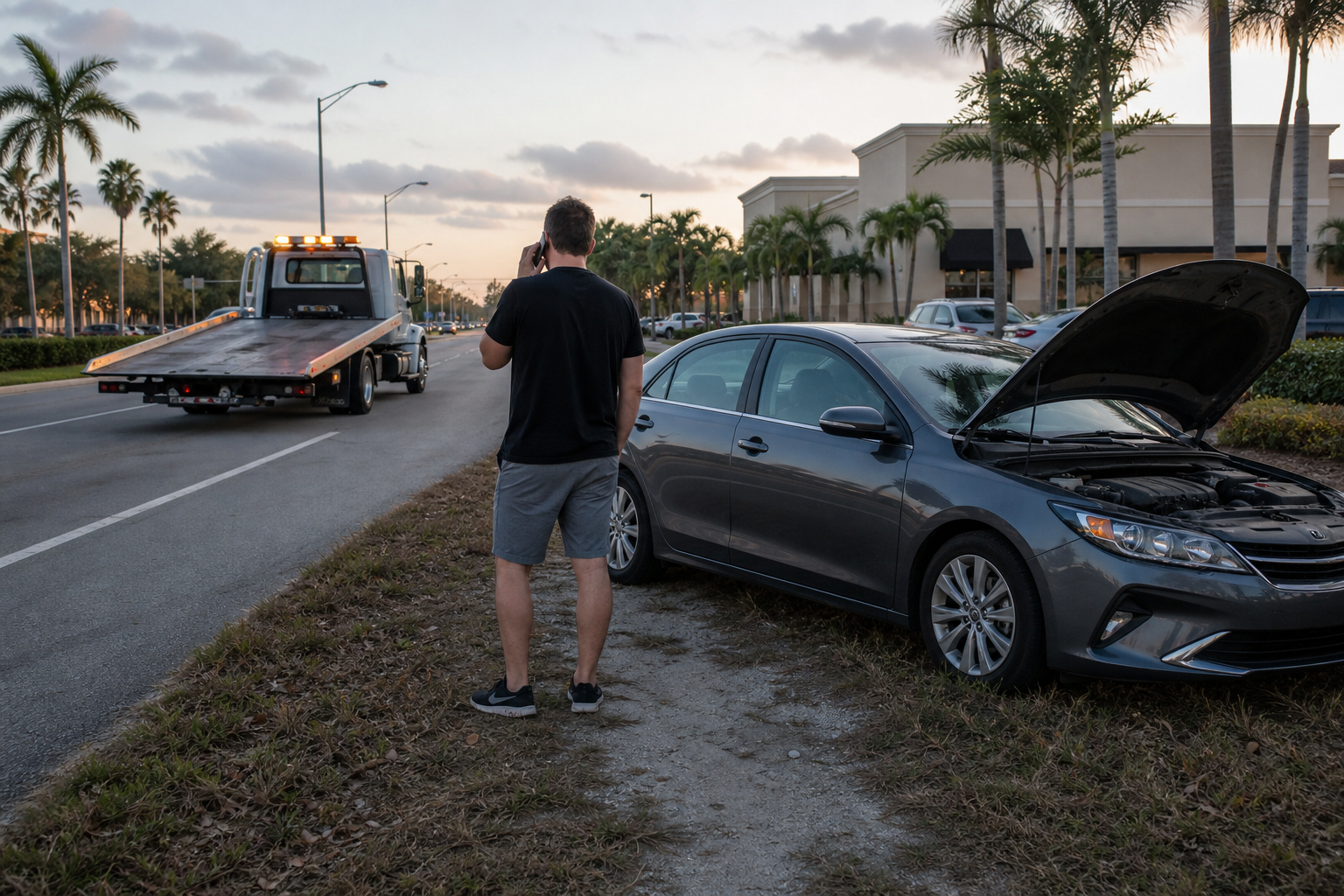
The highest-risk mistake is trying to keep driving a vehicle that may no longer be safe to control. A car that is smoking, leaking, damaged, overheating, losing power, making severe noises, or behaving unpredictably should not be driven just to reach a more convenient spot. The safer alternative is to get out of immediate exposure only if moving the vehicle does not add danger, then arrange towing.
If you are stranded in West Palm Beach, your job before the truck arrives is not to diagnose the problem or make a difficult drive work. Your job is to protect people, make the vehicle findable and reachable, and give the towing operator a clean handoff.
The first three minutes: protect the scene
Picture a common situation: your vehicle stops responding as expected, you are in an unfamiliar lot or along a busy area of West Palm Beach, and your first instinct is to restart it, creep forward, or search for a better place to wait. Pause before doing any of that.
Immediate-action card
- Stop adding risk. Shift into park, set the parking brake if appropriate, and turn on hazard lights.
- Check the vehicle’s condition. Do not restart or drive it if you see smoke, smell burning, see fluid leaking, notice serious collision damage, have a warning that affects drivability, or cannot confidently control steering, braking, or acceleration.
- Choose a safer waiting position. If the vehicle is already in a reasonably protected location, stay put. If it is exposed to moving traffic and can be moved safely without worsening the condition, move only the short distance needed to reduce exposure.
- Move people deliberately. Keep occupants away from active traffic and away from the side of the vehicle facing traffic. If anyone faces immediate danger or injury, contact emergency services first.
- Request the right help. For a vehicle that should not be driven, request 24-hour towing rather than attempting another restart.
Hazard lights help other drivers notice a stopped vehicle, but they do not make an unsafe stopping position safe. Avoid standing between your vehicle and traffic, leaning into the engine area near smoke, or waiting directly behind the vehicle.
Make the tow-versus-drive call before you create a second problem
A tow is usually the better decision when driving could cause a loss of control, worsen visible damage, create a fire risk, or leave you stranded again a few minutes later. In Palm Beach, Florida, a short drive can still be too much if the vehicle is not operating normally.
| What you notice | Best next move |
|---|---|
| Smoke, a burning odor, visible leaking fluid, or severe overheating signs | Stop operating the vehicle and request a tow. |
| Collision damage, a loose-looking wheel area, scraping, dragging parts, or a vehicle sitting unusually low | Do not try to drive it. Tell dispatch about the damage and request towing. |
| Steering, braking, acceleration, transmission movement, or engine response feels unreliable | Tow it. Do not test-drive a vehicle that may be difficult to control. |
| The vehicle starts and moves normally, with no warning signs or damage | Use your judgment about a nearby safe destination, but stop and call for roadside help if the concern returns. |
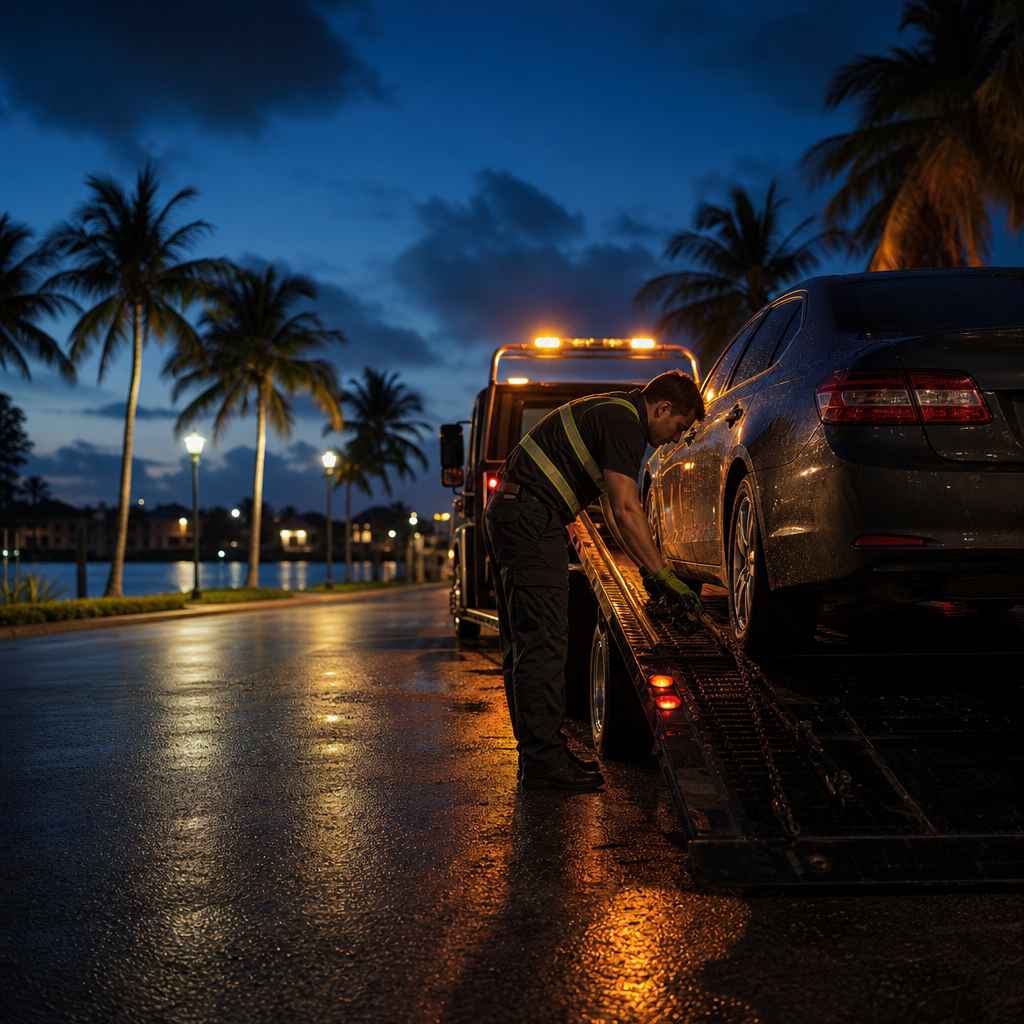
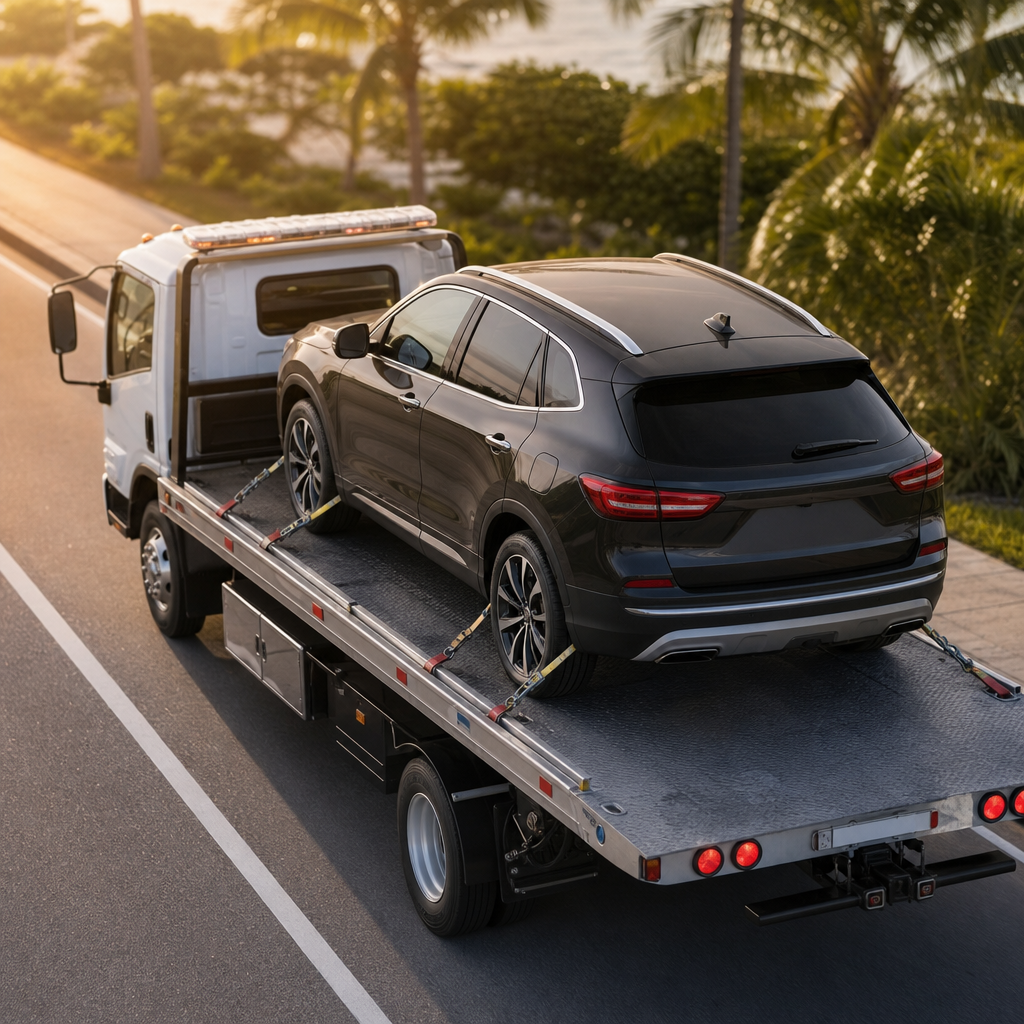
If the vehicle needs to be carried rather than pulled with wheels on the ground, ask for flatbed towing. Describe what you can see rather than guessing at a mechanical cause: “front wheel area damaged,” “vehicle will not shift,” “car is low to the ground,” or “smoke came from under the hood” is useful information.
Set up a pickup the driver can actually reach
The tow truck needs enough information to locate the vehicle and enough space to approach it. A clear pickup description can prevent a stressful delay.
- Give the exact type of location: roadway shoulder, driveway, apartment parking area, business lot, garage entrance, or another accessible place.
- Describe the vehicle: color, year, make, model, and license plate if requested.
- State its orientation: facing in, facing out, nose against a curb, backed into a space, or blocked by another vehicle.
- Flag access limits early: gates, gate codes, a narrow drive, low overhead clearance, a closed parking area, or a vehicle that cannot roll.
- Keep the phone available: answer calls from the towing provider and keep the ringer on until the driver has located you.
Do not try to push a disabled vehicle into a more convenient position unless it can be done safely and without entering traffic exposure. If the vehicle is boxed in, parked in a tight area, or cannot be shifted, say so during the request. That information affects how the driver plans the recovery.
Before the truck pulls up: prepare the vehicle, not a repair attempt
Use the waiting time to gather what the towing operator will need. This is a practical handoff checklist, not a reason to keep troubleshooting.
Pickup-ready checklist
- Take valuables, medications, documents, and essential personal items out of the vehicle if it is safe to do so.
- Have the keys available and know where the vehicle will be taken.
- Confirm the destination address, including any useful entry or access details.
- Tell the dispatcher if the vehicle is locked, will not start, will not shift, has flat tires, has collision damage, or cannot roll freely.
- Remove loose items from around the vehicle that could interfere with loading, but do not crawl underneath it or work near traffic.
- Keep children and other passengers in a safer waiting position, away from the loading path.
If access is difficult or the vehicle condition is unclear, use 24-hour towing service and explain the limitation before arrival. Clear facts allow the provider to send equipment suited to the situation.
The service handoff: the details that matter
When the tow driver arrives, lead with the information that changes the loading plan: what happened, whether the vehicle can roll or shift, visible damage, and the destination. Point out hazards or access restrictions from a safe position. Then follow the operator’s instructions about keys, personal belongings, and where to wait during loading.
A useful handoff sounds like this: “The vehicle is in a parking area in West Palm Beach. It is facing toward the exit, will not start, and cannot be moved. There is visible damage near the front wheel. I need it taken to this destination, and the gate requires access instructions.”
If your vehicle cannot be operated normally, has visible damage, or puts you in an exposed position, choose towing now rather than attempting one more drive. Request a flatbed tow when the vehicle needs to be carried, and share the access details before the truck is dispatched.
Quick answers while you wait
Should I move my car before the tow truck arrives?
Only move it if doing so clearly reduces immediate danger and the vehicle can be operated safely. Do not move a vehicle that is smoking, leaking, damaged, overheating, or difficult to control.
What should I tell the towing dispatcher?
Provide your location type, vehicle description, condition, whether it can roll or shift, any visible damage, access restrictions, and the destination. Mention if a flatbed may be needed.
Do I need to stay with the vehicle?
Remain reachable and follow the provider’s instructions. If waiting beside the vehicle exposes you to traffic or another immediate hazard, move to a safer nearby position while keeping your phone on.
Why does vehicle orientation matter for a tow?
A vehicle facing into a tight space, blocked by another car, sitting against a curb, or unable to roll may require a different approach. Sharing that detail before arrival helps the driver prepare.
What belongs in the vehicle before it is towed?
Keep the keys available for the handoff and remove essential personal items if it is safe. Confirm the destination before loading begins.